CITE: 18 PRIMARY SOURCES
The research record, component by component
GHK-Cu, BPC-157, TB-500, and KPV each have their own literature. The blend itself does not.
The research record, briefly
The four KLOW components have separate research records; the blend itself has none. GHK-Cu has the longest publication history — isolated from human plasma in 1973, with decades of topical cosmetic and wound-healing data and a 2018 microarray analysis reporting modulation of roughly 31% of assayed human genes at nanomolar concentrations. BPC-157 is the most heavily studied in animal models, with consistent rodent tendon and gut repair signals, but human data are limited to small case series and one 2025 IV safety pilot. TB-500 is the actin-binding fragment of Thymosin Beta-4 — most efficacy findings belong to the full-length native protein, not the short fragment. KPV has gut mucosal data in cells and mouse models, with no published controlled human trial. A 2025 systematic review concluded the human evidence base for BPC-157 is insufficient to support clinical recommendation; the 2025 Cureus narrative review reached the same conclusion and tied the gap to FDA Category 2 standing. The combination has never been tested in any controlled study.
Why the blend has no literature of its own
KLOW is not a fixed-dose combination drug. No regulatory agency has reviewed the four peptides together, no pharmacopeial monograph defines the 50/10/10/10 mg ratio, and no published controlled trial has tested the combination in animals or humans. What exists is a research record for each component individually, plus a vendor convention that pools them in one vial. Everything below covers the per-component record; readers should not extrapolate from a single-component study to the behavior of the blend.
GHK-Cu — the copper-tripeptide
GHK-Cu was isolated from human plasma in 1973 and has the longest research history of the four. The most-cited recent paper is a 2018 microarray analysis by Pickart and Margolina, which reported that 1 nM GHK-Cu modulated the expression of roughly 31.2% of the 23,500 assayed human genes, upregulating pathways for DNA repair, antioxidant defense (superoxide dismutase, catalase), and tissue remodeling while downregulating inflammatory and pro-fibrotic genes [01]. A 2015 review in BioMed Research International described accelerated wound healing and elevated dermal antioxidant capacity in rabbit topical studies [02]. A 2023 paper in the Journal of Cosmetic Dermatology reported that GHK-Cu paired with low-molecular-weight hyaluronic acid at a 1:9 mass ratio increased collagen IV synthesis 25.4-fold in cultured human fibroblasts and 2.03-fold in ex-vivo skin explants [03]. Mechanistically, GHK-Cu acts as a copper-shuttling signal that activates lysyl oxidase and lysyl hydroxylase, the enzymes responsible for collagen cross-linking. The plasma half-life is reported on the order of minutes, with most research conducted at micromolar concentrations in cell culture or as topical formulations at 0.1–3 mg/mL.
BPC-157 — the pentadecapeptide
BPC-157 (15 amino acids, sequence GEPPPGKPADDAGLV) is the most heavily studied of the four in animal models. A 2003 paper in the Journal of Orthopaedic Research reported that 10 μg/kg or 10 ng/kg intraperitoneal BPC-157 accelerated healing of transected rat Achilles tendons, producing greater load-to-failure and superior collagen formation versus vehicle [04]. A 2010 follow-up demonstrated an early-phase increase in angiogenesis with elevated VEGF and CD34 immunopositivity in the same rat tendon model [05]. A 2017 paper in the Journal of Molecular Histology established the VEGFR2-Akt-eNOS pathway as the mechanistic axis: angiogenic tube formation in human umbilical vein endothelial cells was abolished by VEGFR2, PI3K, Akt, or eNOS inhibition [06]. The cytoprotective profile extends beyond tendons: a 2020 review in Gut and Liver linked BPC-157 to upregulation of heme oxygenase-1 and heat shock proteins, with preserved mitochondrial integrity across multiple rodent injury models [17]. Human data is sparse. A 2024 open-label pilot in 12 women with refractory interstitial cystitis reported symptom resolution at six weeks in 10 of 12 participants — uncontrolled, very small n, single site [07]. A 2025 systematic review in HSS Journal screened 544 articles published between 1993 and 2024 on BPC-157 musculoskeletal healing, identified 36 studies (35 preclinical, 1 clinical), and concluded that despite consistent rodent benefit signals the human evidence base is insufficient to support clinical recommendation [08]. A 2025 narrative review in Cureus reached the same conclusion and explicitly called for randomized controlled trials [18]. Reported rat plasma half-life is roughly 4 hours; BPC-157 is reported as stable in human gastric juice for at least 24 hours, which is one of the rationales cited for oral administration in research settings.
TB-500 — the Thymosin Beta-4 fragment
TB-500 is sold as a synthetic 17-residue fragment marketed as an analog of the actin-binding region of Thymosin Beta-4, the principal G-actin sequestering peptide in mammalian cells [13]. A 2007 paper in Clinical Ophthalmology reported that 0.1% topical Tβ4 accelerated corneal epithelial healing and reduced inflammation in rodent and rabbit models, with effects attributed to enhanced cell migration and reduced neutrophil infiltration [15]. Full-length recombinant Thymosin Beta-4 (RGN-259) reached Phase 3 human clinical trials for dry eye disease and neurotrophic keratopathy; an earlier Phase 2 study in diabetic corneal wounds (NCT00598871) was terminated for slow accrual rather than safety [14]. A 2025 paper in Investigative Ophthalmology and Visual Science described an engineered tandem Tβ4 construct that accelerated corneal epithelial healing in animal models, supporting continued ophthalmic development of the full-length molecule. The distinction matters: the TB-500 fragment sold as research material is not the same drug substance as full-length recombinant Tβ4, and clinical-trial data on RGN-259 does not transfer directly to the fragment [14]. Full-length Tβ4 has a reported plasma half-life of about 2 hours in humans; published pharmacokinetic data on the TB-500 fragment is sparse.
KPV — the alpha-MSH C-terminal tripeptide
KPV (Lys-Pro-Val) corresponds to residues 11-13 of alpha-melanocyte-stimulating hormone. The most-cited mechanistic paper is a 2008 Gastroenterology study by Dalmasso and colleagues, which demonstrated that KPV is transported into intestinal epithelial and immune cells by the PepT1 di/tripeptide transporter with a Km of approximately 160 μmol/L; intracellular KPV reduced NF-κB and MAPK activation and IL-8 secretion, and oral KPV decreased inflammation in DSS- and TNBS-induced murine colitis [09]. A 2006 paper in Peptides showed that immobilized alpha-MSH 10-13 (GKPV) inhibited TNF-α-stimulated NF-κB activity in HEK reporter assays, providing the molecular basis for the anti-inflammatory profile observed in colitis and skin inflammation models [10]. More recent work has focused on targeted delivery: a 2023 Bioactive Materials paper described hybrid lipid hyaluronate-KPV conjugated nanoparticles producing combined mucosal healing and immunomodulation in a murine ulcerative colitis model [11], and a 2024 review in Cellular and Molecular Gastroenterology and Hepatology reported that PLGA-KPV nanoparticles coated with montmorillonite/chitosan selectively accumulated in inflamed colonic epithelium for up to 36 hours [12]. KPV is rapidly degraded by intestinal peptidases but is reported to retain activity via PepT1-mediated cellular uptake. No published controlled human trial of KPV exists.
The unpublished Pliva PL 14736 program
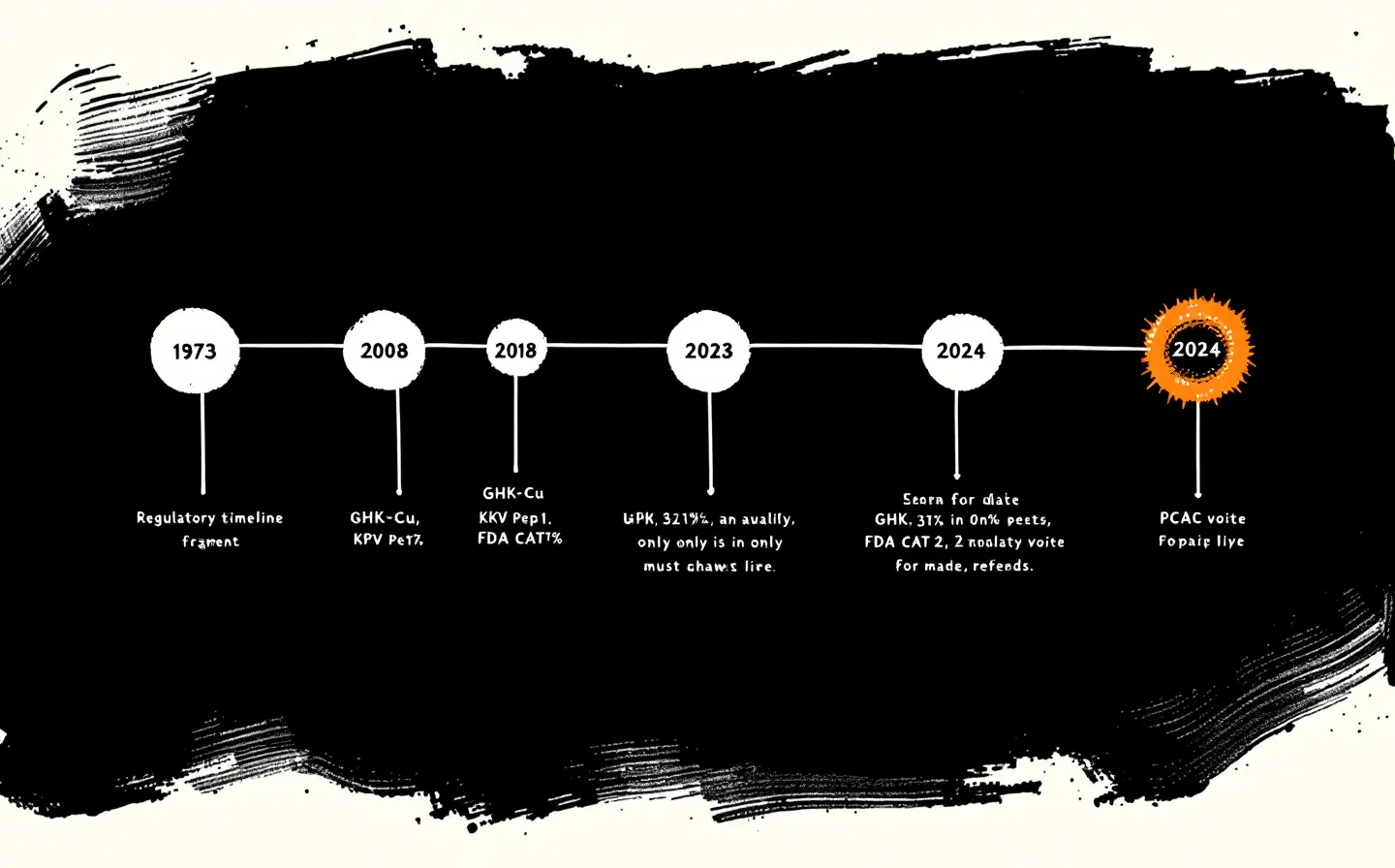
BPC-157's most notable human program was the Pliva PL 14736 development effort for inflammatory bowel disease. Animal work in the Klicek and colleagues 2008 study reported that BPC-157 promoted healing of colocutaneous fistulas in a rat ulcerative colitis model, with the effect attributed to nitric-oxide-system modulation [16]. The same paper described rectal PL 14736 as having been evaluated in Phase 1 healthy-volunteer safety work. The Pliva Phase 2 ulcerative colitis trial reportedly completed but was never published in a peer-reviewed clinical paper [16]. Without published methods, results, and adverse-event reporting, the trial cannot be cited as evidence of efficacy or safety in humans. This unpublished status is part of what the 2025 systematic review meant when it concluded that the human evidence base is insufficient [08].
What a 2025 systematic review concluded
The 2025 HSS Journal systematic review on BPC-157 in orthopaedic sports medicine is the most rigorous recent assessment of any KLOW component. The reviewers screened 544 articles published between 1993 and 2024 and included 36 studies — 35 preclinical and one clinical [08]. Their conclusion: the rodent benefit signals are consistent across tendon, muscle, and bone injury models, but the absence of adequately powered randomized human trials precludes clinical recommendation. The 2025 Cureus narrative review reached a parallel conclusion and explicitly tied the evidence gap to the FDA Category 2 standing [18]. Neither review addressed the KLOW blend as a combination. A 2025 Investigative Ophthalmology and Visual Science paper describing an engineered tandem Tβ4 construct that accelerated corneal epithelial healing in animal models is the most recent indexed advance on any KLOW-adjacent compound; the work supports continued ophthalmic development of full-length Thymosin Beta-4 but does not transfer to the TB-500 fragment.